







Fibo Bands
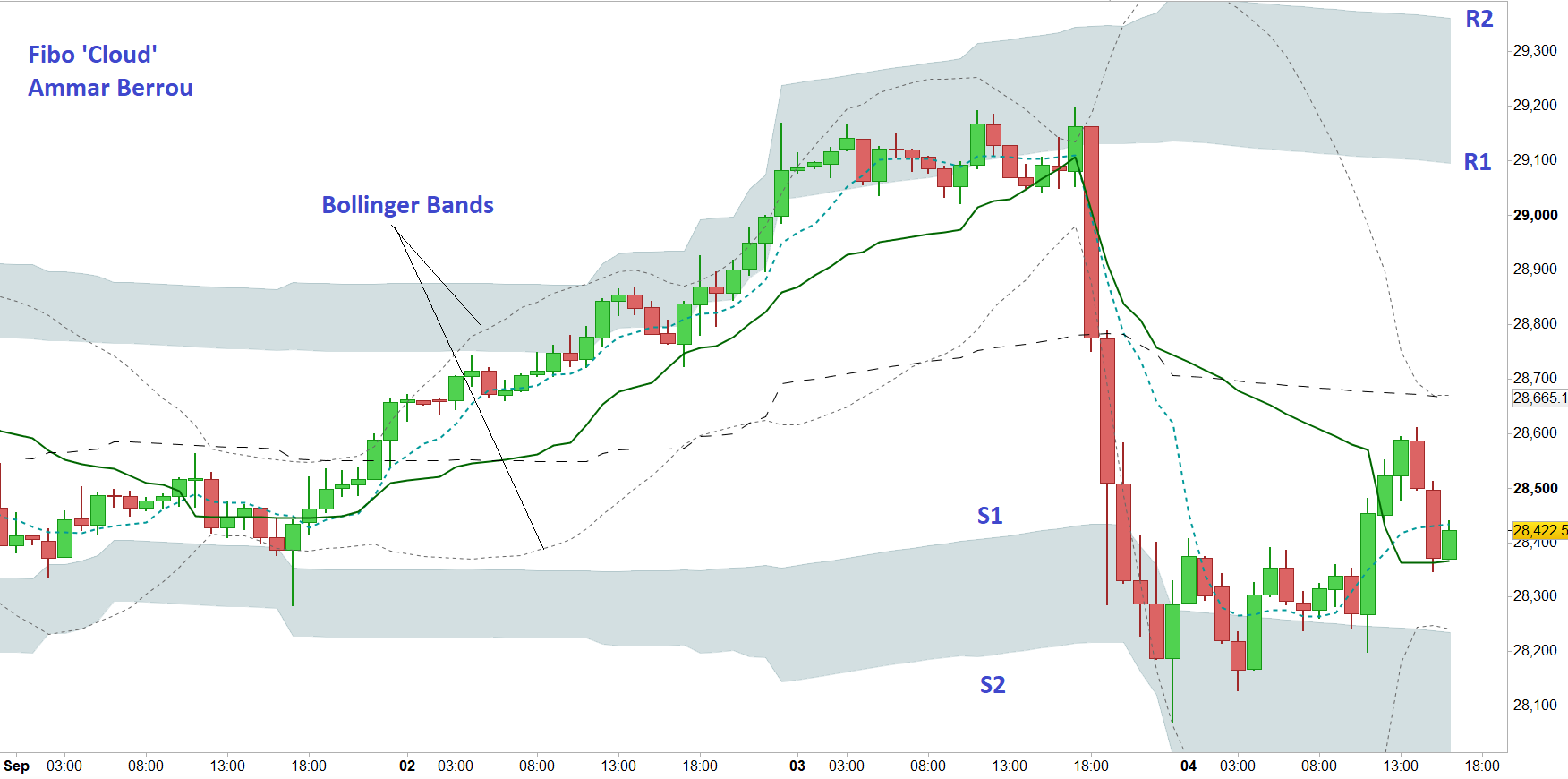
I hope you find it useful, in this post, I’ll explain my proposal to enhance Fibonacci levels, share the code, and the ready indicator attached for convenience.
The image is DOW future Hourly chart (Fri 4th Sep), as you see the ‘Fibo Bands’ gives much better bounds to the market compared to Bollinger Bands,
For clarity I added a grey color fill between R1/R2 and S1/S2, the lower grey zone would be the ‘ground’ and the upper is the ‘cloud’.
Needless to say, the longer time frames (day, week) respects those boundaries even more, but it is stronger proof of my claim to use it on hourly chart.
Conventionally in Fibo levels, it is calculated for last price only, here it is continuous, and visually this one is easier to comprehend.
How to trade it: whenever the price reaches one of the grey zones look for a rebound (swing) or a new trend, a higher time frame would help, as usual wait for 2nd or 3rd confirmation, volume shall confirm the signal.
here’s the pro-real-time code:
Parameters:
extreme (boolean) to calculate the range based on open/close or high/low
History (integer) how many candles to search for the range, I suggest 50
Average (integer) average period, I suggest 30 to 50
reason I made History different from Average, is to allow the indicator to see more history than the average if needed.
You need a color fill between R1 & R2, S1 & S2
I usually hide S3, R3 and dif, less is more
//created by Ammar Berrou
//www.linkedin.com/in/a-berrou

extreme = 1
history = 50
iaverage = 30
// ---------

if extreme then
 hh= Highest[History](high)
else
 hh = Highest[History](close)
endif

if extreme then
 ll=lowest[History](low)
else
 ll=lowest[History](close)
endif

PP = (hh + ll + average[iAverage](close)) / 3
dif = (hh - ll)
dif3 = (dif* 1.000)
dif2=(dif * 0.618)
dif1 = (dif * 0.382)
Rr3 = PP + dif3
Rr2 = PP + dif2
Rr1 = PP + dif1

Ss1 = PP - dif1
Ss2 = PP - dif2
Ss3 = PP - dif3

return PP as "Pivot", dif as "Histogram", rr1 as "R1", rr2 as "R2",rr3 as "R3", ss1 as "S1",ss2 as "S2",ss3 as "S3"
What parameter should we change to make another channel appear in the higher or lower time unit? make the H1 channel appear on an H4 graph for example